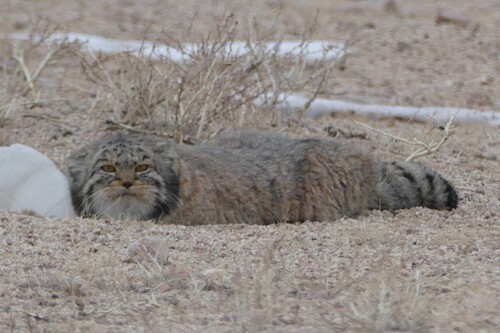
Photo: (c) Sara Navarro, some rights reserved (CC BY) — via iNaturalist
Pallas's Cat
Otocolobus manul
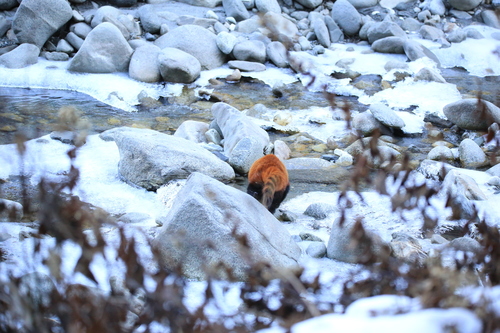
Hides among rocks and grass on cold, high steppe.
About the Pallas's Cat
Pallas's cat, or the manul, is a small wild cat of the Central Asian steppe and mountain, and it looks perpetually disgruntled — a consequence of a flattened face with high-set eyes and a very dense coat that makes it appear far heavier than it is. It has the longest and thickest fur of any cat, which it needs at the altitudes and temperatures it occupies.
How it lives
Manuls are ambush hunters of pikas and small rodents, working rocky ground and steppe grassland where they can use cover. They are poor runners and rely entirely on stalking and short rushes, flattening themselves against rock or freezing in place — the low-set eyes let them peer over a ridge with almost nothing showing. They shelter in rock crevices and in burrows taken from marmots and foxes. Unusually among cats, their pupils contract to circles rather than slits.
Where it lives
Hides among rocks and grass on cold, high steppe. Its main habitat is the Central Asian Steppe, where the climate is harsh extremes — baking summers and deeply frozen winters.
Notable facts
- It has the fluffiest fur of any wild cat.
- Its grumpy round face is internet-famous.
- Low-set ears help it peek over rocks unseen.
Conservation
IUCN Red List status: Least concern. Assessed as not currently at risk of extinction in the wild.
Pallas's cat is listed as of least concern following reassessment, but it is naturally sparse and thinly distributed over an enormous area, so the estimate carries real uncertainty. The pressures are the poisoning of pikas and rodents as agricultural pests, which removes its food supply directly, trapping and killing by herding dogs, and habitat degradation from overgrazing. Kittens have high mortality and the species does badly in captivity.
Read the Wikipedia article →Habitats where the Pallas's Cat is found
Central Asian Steppe
The wild, wind-blown grasslands and deserts of Mongolia and Central Asia.
187 species recorded →Himalayas & High Asia
The rooftop of the world, where ghostly cats prowl above the clouds.
353 species recorded →