Photo: (c) Andrew Bazdyrev, some rights reserved (CC BY) — via iNaturalist
Bactrian Camel
Camelus bactrianus
Crosses the Gobi Desert through scorching summers and frozen winters.
About the Bactrian Camel
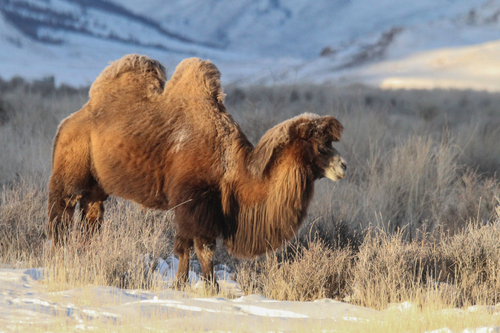
The wild Bactrian camel is the two-humped camel of the Gobi and the Taklamakan, and it is a genuinely different animal from the domestic Bactrian rather than a feral version of it — the two lineages separated long before domestication. It is slighter, faster and more slender than the domestic form, with smaller conical humps.
How it lives
It survives in country that offers almost nothing: extreme temperature swings, sparse vegetation, and water that is often salt. Wild Bactrians can drink brackish and even salt water that would kill livestock, an ability the domestic camel does not have. The two humps store fat and shrink when food runs short. They eat whatever is available including thorny scrub and dry, salty plants, and they range over enormous distances between water sources, moving in small groups.
Where it lives
Crosses the Gobi Desert through scorching summers and frozen winters. Its main habitat is the Central Asian Steppe, where the climate is harsh extremes — baking summers and deeply frozen winters.
Notable facts
- It has two humps, unlike the Arabian camel.
- It survives both +40°C and −30°C.
- It grows a thick shaggy coat for winter, then sheds it.
Conservation
IUCN Red List status: Critically endangered. Facing an extremely high risk of extinction in the wild.
This is one of the most endangered large mammals in the world, with a wild population of only a few hundred split between China and Mongolia. The threats are hunting, competition with domestic livestock for scarce water, predation on the small population by wolves at those same water points, and mining development. Interbreeding with domestic Bactrians is a serious additional risk, since it would erase the distinct wild genome.
Read the Wikipedia article →