Photo: no rights reserved — via iNaturalist
Himalayan Tahr
Hemitragus jemlahicus
Clings to near-vertical cliffs in the high Himalayas.
About the Himalayan Tahr
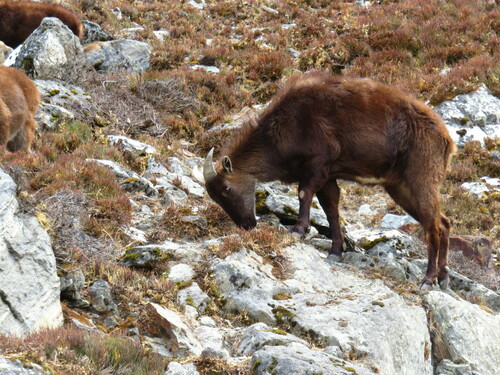
The Himalayan tahr is a stocky wild goat relative of the steep forested slopes and cliffs of the Himalaya, from northern India through Nepal to Tibet. Males carry a heavy ruff of hair over the neck and shoulders that gets longer and redder as winter comes, and both sexes have short backswept horns.
How it lives
Tahr are supremely capable on near-vertical rock, with flexible hooves that combine a hard rim for edging with a soft, rubbery centre for grip. They graze and browse grasses, herbs and shrubs, moving up the mountain in summer and down into forest in winter. Females and young form herds; males join for the autumn rut, when they display with the ruff, spar with horns, and posture side-on to look as large as possible. Their eyesight is excellent and they retreat to ground where nothing can follow.
Where it lives
Clings to near-vertical cliffs in the high Himalayas. Its main habitat is the Himalayas & High Asia, where the climate is bitterly cold with thin air, snow and fierce winds.
Notable facts
- It scales cliffs that look impossible to climb.
- A thick reddish mane shields it from mountain cold.
- Special hooves grip slick rock like rubber.
Conservation
IUCN Red List status: Near threatened. Not threatened today, but close to qualifying and likely to become so without action.
The species is near threatened in its native range, where hunting and competition with domestic livestock for winter grazing have reduced numbers. The reverse problem exists where it was introduced: in New Zealand, tahr established without predators and reached densities that damaged alpine plant communities badly enough to require large-scale control, a reminder that the same animal can be a conservation priority in one place and a target in another.
Read the Wikipedia article →