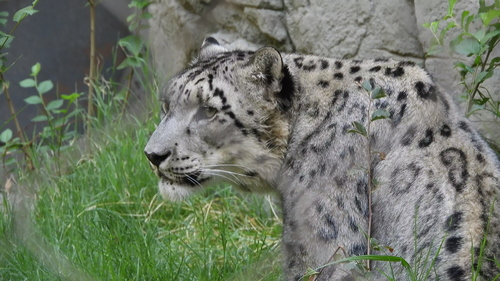
Photo: (c) Mary K. Hanson, some rights reserved (CC BY) — via iNaturalist
Snow Leopard
Panthera uncia
Stalks steep, snowy mountain slopes, almost never seen by people.
About the Snow Leopard
The snow leopard is a cat of high, cold, broken mountain country across Central and South Asia, and it is famously hard to see — pale smoky grey with dark rosettes, moving through rock and snow that it matches almost exactly. The tail is nearly as long as the body, used for balance on steep ground and wrapped around the animal like a scarf when it rests.
How it lives
Snow leopards hunt blue sheep, ibex, argali and marmots on terrain that would defeat almost any other predator, launching short attacks from above and taking prey several times their own weight. Enormous paws work as snowshoes, a deep chest handles thin air, and dense fur — including on the soles of the feet — handles the cold. They cannot roar. They are solitary, hold very large territories, and mark them with scrapes and scent along ridgelines they reuse for years.
Where it lives
Stalks steep, snowy mountain slopes, almost never seen by people. Its main habitat is the Himalayas & High Asia, where the climate is bitterly cold with thin air, snow and fierce winds.
Notable facts
- Nicknamed the 'ghost of the mountains'.
- Its huge tail works as a balance bar and a scarf.
- It can leap up to 15 m in a single bound.
Conservation
IUCN Red List status: Vulnerable. Facing a high risk of extinction in the wild.
The species is vulnerable, spread thinly across twelve countries at densities that make it hard to count. The main pressures are retaliatory killing after livestock losses, poaching for pelts and bones, and depletion of wild prey by hunting and by competition with domestic herds. Livestock insurance schemes and predator-proof corrals have measurably cut retaliatory killing where they have been introduced.
Read the Wikipedia article →