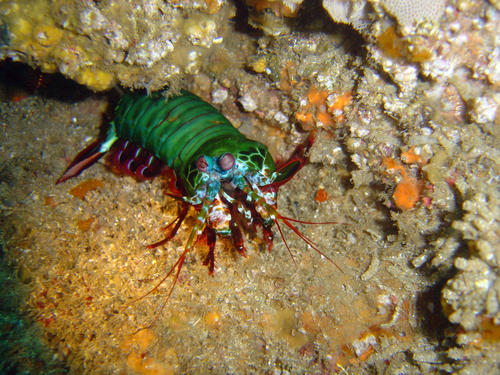
Photo: (c) Peter Southwood, some rights reserved (CC BY-SA) — via iNaturalist
Peacock Mantis Shrimp
Odontodactylus scyllarus
Guards burrows in shallow tropical reefs.
About the Peacock Mantis Shrimp
The peacock mantis shrimp is a small, brilliantly coloured crustacean of Indo-Pacific reefs, and it holds two of the more remarkable records in the animal world: one of the fastest movements ever measured in a living thing, and the most complex eyes known.
How it lives
Its raptorial appendages are club-shaped and spring-loaded, released with an acceleration comparable to a bullet leaving a gun. The strike is fast enough to boil the water in its wake into a cavitation bubble, and the bubble's collapse delivers a second blow along with a flash of light and a burst of heat. This is used to shatter crab and snail shells, and captive animals have broken aquarium glass. The eyes are mounted on stalks, move independently, and carry many more classes of photoreceptor than human eyes, including receptors for ultraviolet and for circular polarised light, which no other animal is known to detect.
Where it lives
Guards burrows in shallow tropical reefs. Its main habitat is Coral Reefs & Oceans, where the climate is warm, sunlit tropical seas in the shallows; cold and dark in the deep.
Notable facts
- Its punch is as fast as a bullet from a gun.
- It has the most complex eyes in the animal kingdom.
- The strike boils the water around it for a split second.
Conservation
IUCN Red List status: Least concern. Assessed as not currently at risk of extinction in the wild.
Mantis shrimp are not assessed as threatened and remain common on healthy reefs. They are collected in modest numbers for the aquarium trade, where they are regarded with some caution. Their fortunes are tied to the reefs themselves — they need rubble, burrows and crevices, and lose all of that when coral is bleached and reduced to flat pavement.
Read the Wikipedia article →