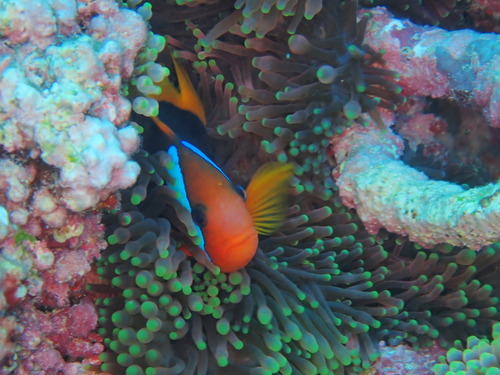
Photo: (c) Daniel Eisenhauer, some rights reserved (CC BY) — via iNaturalist
Clownfish
Amphiprioninae
Lives among the stinging tentacles of sea anemones.
About the Clownfish
Clownfish, or anemonefish, are small reef fish that live inside sea anemones whose stinging tentacles would immobilise almost any other fish of their size. The relationship is the reason anyone knows them: the fish gains a defended home, and the anemone gains a defender, better water circulation and nutrients from its lodger.
How it lives
Protection comes from a mucus coat that keeps the anemone from recognising the fish as prey, and a young clownfish acclimates to a new host gradually, touching it in short bouts until the coating is established. Each anemone holds a strict hierarchy — a large breeding female, a smaller breeding male, and several non-breeding juveniles held in check by the ones above them. All clownfish are born male, and when the female dies the breeding male changes sex to replace her while the largest juvenile moves up. Eggs are laid on rock beside the anemone and guarded by the male.
Where it lives
Lives among the stinging tentacles of sea anemones. Its main habitat is Coral Reefs & Oceans, where the climate is warm, sunlit tropical seas in the shallows; cold and dark in the deep.
Notable facts
- It's immune to its anemone home's sting.
- All clownfish are born male; one becomes female.
- It almost never strays far from its anemone.
Conservation
IUCN Red List status: Least concern. Assessed as not currently at risk of extinction in the wild.
Clownfish are of least concern, but they are entirely dependent on their host anemones, and anemones bleach and die under heat stress exactly as corals do. Collection for the aquarium trade was a serious pressure until captive breeding became routine, and most clownfish sold now are tank-bred. Reef degradation is the pressure that matters.
Read the Wikipedia article →