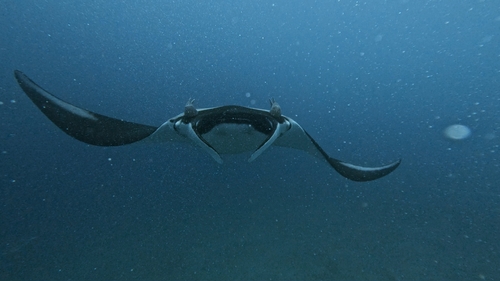
Photo: (c) Victor E. Chocho, some rights reserved (CC BY) — via iNaturalist
Manta Ray
Mobula birostris
Soars through open ocean and reefs, filtering tiny plankton.
About the Manta Ray
The giant manta is the largest ray in the world, with a wingspan that can exceed seven metres. It is a filter feeder with no sting — the tail carries no barb — and it moves by flapping its pectoral fins in a motion much closer to flight than to swimming. The paired cephalic fins at the front unroll to funnel water into the mouth and roll up when the animal is cruising.
How it lives
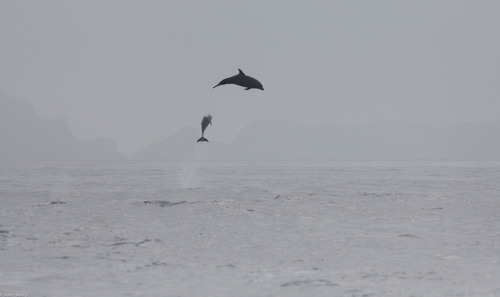
Mantas feed on zooplankton, straining it through a fine sieve of gill plates, and will barrel-roll repeatedly through a dense patch of plankton to keep passing through it. They have the largest brain-to-body ratio of any fish, appear to recognise themselves in mirrors, and visit cleaning stations on reefs where small fish remove parasites — returning to the same stations for years. They breach clear of the water for reasons still argued over. Each animal carries a unique pattern of belly markings used to identify it.
Where it lives
Soars through open ocean and reefs, filtering tiny plankton. Its main habitat is Coral Reefs & Oceans, where the climate is warm, sunlit tropical seas in the shallows; cold and dark in the deep.
Notable facts
- It has the largest brain of any fish.
- Its 'wings' can span up to 7 m.
- It seems to leap from the water just for fun.
Conservation
IUCN Red List status: Endangered. Facing a very high risk of extinction in the wild.
Giant mantas are endangered. They give birth to a single pup at intervals of a couple of years, which is among the lowest reproductive rates of any fish, so any sustained mortality drives decline. They are targeted for their gill plates, which are sold for use in traditional remedies, and taken as bycatch in nets and longlines. They are now protected under international trade rules and in the waters of a number of countries, and manta tourism has given several of those countries a direct economic reason to keep them.
Read the Wikipedia article →