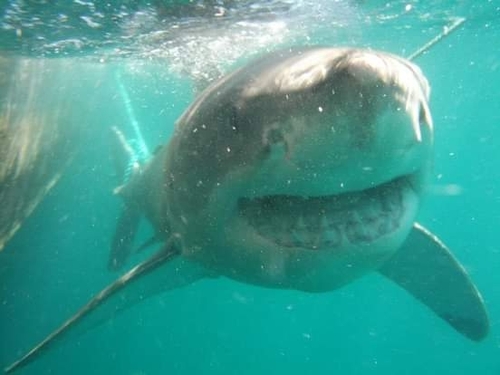
Photo: (c) Michel Frisch, some rights reserved (CC BY) — via iNaturalist
Great White Shark
Carcharodon carcharias
Cruises coastal waters worldwide, a powerful ocean predator.
About the Great White Shark
The great white is the largest predatory fish in the world and among the most studied and most misrepresented animals alive. It is countershaded — dark grey above, white below — so that it disappears against the sea floor from above and against the light from below. It is not cold-blooded in the ordinary sense: a heat-exchange system in its blood vessels keeps its muscles, stomach and brain warmer than the water, which is what allows it to hunt fast prey in cold seas.
How it lives
Great whites detect prey by scent, by hearing and by electroreception through pores in the snout that pick up the electrical fields of muscle movement. Attacks on seals are launched vertically from deep water at speed. They range enormously — individuals have crossed entire oceans and returned to the same coastal sites — and they aggregate at particular offshore locations for reasons that are still not fully explained. They grow slowly, mature late and produce small numbers of live young.
Where it lives
Cruises coastal waters worldwide, a powerful ocean predator. Its main habitat is Coral Reefs & Oceans, where the climate is warm, sunlit tropical seas in the shallows; cold and dark in the deep.
Notable facts
- It can detect a single drop of blood in the water.
- It rolls its eyes back to protect them when biting.
- It must keep swimming to keep water over its gills.
Conservation
IUCN Red List status: Vulnerable. Facing a high risk of extinction in the wild.
The species is vulnerable and declining in most regions where it has been assessed. Slow reproduction makes it very sensitive to mortality, and the main sources are bycatch in commercial fisheries, targeted fishing for jaws, teeth and fins, and beach protection nets and drumlines. It is now legally protected in many countries. Attacks on people are rare and rarely predatory, but they dominate the species' public standing and complicate its protection.
Read the Wikipedia article →