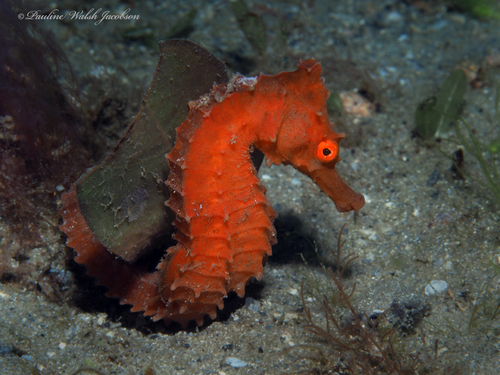
Photo: (c) Pauline Walsh Jacobson, some rights reserved (CC BY) — via iNaturalist
Seahorse
Hippocampus
Clings to seagrass and coral with its curling tail.
About the Seahorse
Seahorses are fish, despite appearances — they have gills, a swim bladder and fins, but they swim upright, propelled by a small dorsal fin beating rapidly, and they are among the slowest fish in the sea. The head sits at an angle to the body, the eyes move independently, and the tail is prehensile and used to hold on rather than to swim.
How it lives
Being slow is not the handicap it looks like, because seahorses are ambush predators: they anchor to seagrass, coral or sponge, wait, and then strike with a pivot of the head so fast that prey has no time to escape. They eat continuously, since they have no stomach and food passes through quickly. They are the only animals in which the male becomes pregnant in the full sense — the female deposits eggs into a brood pouch on his abdomen, where they are fertilised, supplied with oxygen and nutrients, and eventually expelled as fully formed young. Many species pair for a season and greet each other daily.
Where it lives
Clings to seagrass and coral with its curling tail. Its main habitat is Coral Reefs & Oceans, where the climate is warm, sunlit tropical seas in the shallows; cold and dark in the deep.
Notable facts
- It's the dads who get pregnant and give birth.
- It swims upright and very slowly.
- Each eye can look in a different direction.
Conservation
IUCN Red List status: Least concern. Assessed as not currently at risk of extinction in the wild.
Seahorse species vary from least concern to endangered, and the genus as a whole is under real pressure. Tens of millions are taken each year for traditional medicine, for the curio trade as dried ornaments, and for aquariums, much of it as bycatch from trawling. Trawling also destroys the seagrass beds and reefs they need. All seahorses are listed under international trade controls.
Read the Wikipedia article →