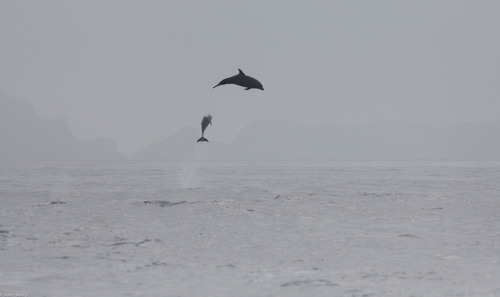
Photo: (c) Adam J. Searcy, some rights reserved (CC BY) — via iNaturalist
Bottlenose Dolphin
Tursiops truncatus
Swims warm coastal seas in playful, chattering pods.
About the Bottlenose Dolphin
The bottlenose dolphin is the most familiar cetacean in the world and among the most cognitively capable non-human animals studied. It lives in coastal and offshore waters through most of the temperate and tropical ocean, and the two main forms — a smaller coastal type and a larger offshore one — differ enough to be considered separate species in some classifications.
How it lives
Dolphins hunt using echolocation, producing clicks through structures in the head and reading the returning echoes with enough resolution to distinguish objects buried in sand. They live in fluid groups that split and reform, and males form long-term alliances. Each dolphin develops a signature whistle that functions much like a name — others copy it to address that individual. Hunting techniques are learned and passed on culturally: mud-ring feeding in Florida, strand feeding in South Carolina, sponge-carrying in Shark Bay, and cooperative herding of fish towards human nets in Brazil.
Where it lives
Swims warm coastal seas in playful, chattering pods. Its main habitat is Coral Reefs & Oceans, where the climate is warm, sunlit tropical seas in the shallows; cold and dark in the deep.
Notable facts
- It finds food using echoes, like natural sonar.
- Each dolphin has its own signature whistle 'name'.
- One of the smartest animals in the ocean.
Conservation
IUCN Red List status: Least concern. Assessed as not currently at risk of extinction in the wild.
Bottlenose dolphins are of least concern overall, though particular local populations are small, isolated and in trouble. The pressures are bycatch and entanglement, boat strikes, underwater noise, chemical pollution that accumulates in blubber and passes to calves in milk, and in some regions direct hunting. Coastal populations are the most exposed because they overlap most with human activity.
Read the Wikipedia article →