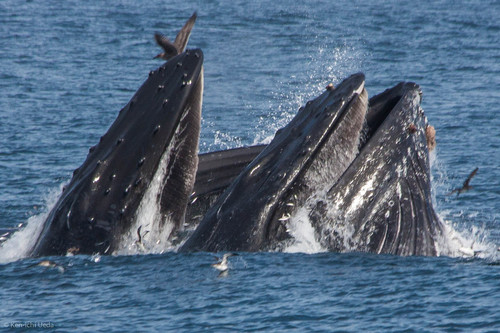
Photo: (c) Ken-ichi Ueda, some rights reserved (CC BY) — via iNaturalist
Humpback Whale
Megaptera novaeangliae
Migrates across whole oceans between feeding and breeding seas.
About the Humpback Whale
The humpback whale is a large baleen whale known for enormous pectoral fins — nearly a third of its body length, the longest appendages of any animal — and for a knobbly head studded with tubercles, each holding a single hair that appears to work as a sensor. Every humpback has a unique pattern on the underside of its tail, which is how individuals are tracked across oceans and decades.
How it lives
Humpbacks feed in cold, productive waters in summer on krill and small schooling fish, then migrate to warm tropical waters to breed and calve, fasting for months in the process — among the longest migrations of any mammal. They are the inventors of bubble-net feeding, in which a group blows a rising spiral of bubbles to concentrate a shoal and then lunges up through the middle of it. Males produce long, structured songs that change progressively through a season, and the changes spread from one population to another across an ocean basin.
Where it lives
Migrates across whole oceans between feeding and breeding seas. Its main habitat is Coral Reefs & Oceans, where the climate is warm, sunlit tropical seas in the shallows; cold and dark in the deep.
Notable facts
- Males sing long, complex songs that travel for miles.
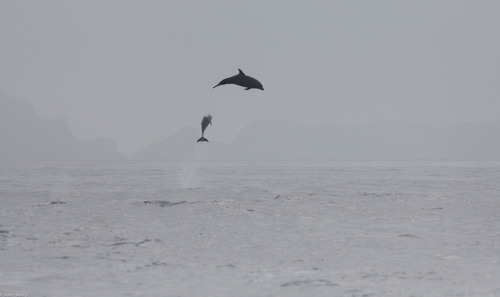
- It leaps its whole body clear of the water.
- Its flippers can be 5 m long — the largest of any animal.
Conservation
IUCN Red List status: Least concern. Assessed as not currently at risk of extinction in the wild.
The humpback is of least concern and its recovery is one of the strongest arguments that whale protection works — the global population fell to a small remnant under commercial whaling and has since rebuilt to a large fraction of its original numbers. Some subpopulations remain depleted. The current threats are entanglement in fishing gear, which is the leading human cause of death, ship strikes, and underwater noise interfering with communication.
Read the Wikipedia article →Habitats where the Humpback Whale is found
Coral Reefs & Oceans
The biggest habitat on Earth — a rainbow reef giving way to endless ocean.
590 species recorded →Antarctica
The white continent at the bottom of the planet — a freezer the size of a continent.
110 species recorded →