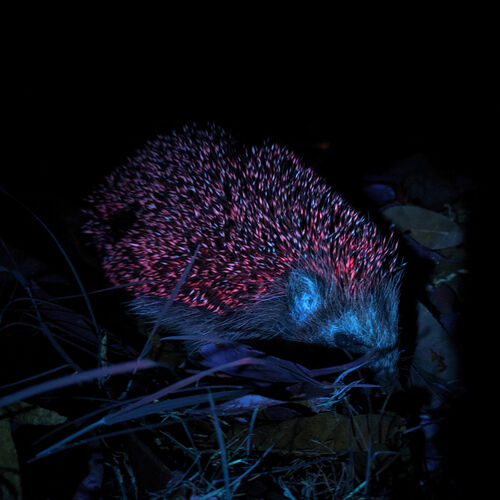
Photo: (c) Stephan Mende, some rights reserved (CC BY) — via iNaturalist
European Hedgehog
Erinaceus europaeus
Snuffles through gardens and hedges at night for insects.
About the European Hedgehog
The European hedgehog is a small nocturnal insectivore covered in several thousand hollow keratin spines, which are modified hairs rather than quills — they are not barbed and do not detach. Its defence is to roll into a ball using a powerful ring of muscle around the edge of the back, presenting nothing but points in every direction.
How it lives
Hedgehogs forage at night across gardens, hedgerows, woodland edge and grassland, covering surprisingly long distances and eating beetles, caterpillars, earthworms, slugs and snails. They locate prey mostly by smell and hearing. In autumn they build up fat and then hibernate through the coldest months in a nest of leaves under a hedge, log pile or shed, waking occasionally to move. They are noisy — snuffling, huffing and, during courtship, circling each other for hours.
Where it lives
Snuffles through gardens and hedges at night for insects. Its main habitat is the European Woodlands, where the climate is mild, temperate seasons with cool rain and gentle summers.
Notable facts
- It has around 5,000 spines on its back.
- When scared it rolls into a tight prickly ball.
- It hibernates through the cold winter months.
Conservation
IUCN Red List status: Least concern. Assessed as not currently at risk of extinction in the wild.
The species is of least concern globally but has declined severely in Britain and parts of northwestern Europe, with rural populations falling especially sharply. The causes are the loss of hedgerows and permanent pasture, intensive farming reducing the invertebrates hedgehogs eat, fragmentation of gardens by solid fencing, road deaths and pesticide use. Small interventions help disproportionately: gaps at the base of fences to link gardens, log piles, and checking bonfires and strimmer lines before use.
Read the Wikipedia article →