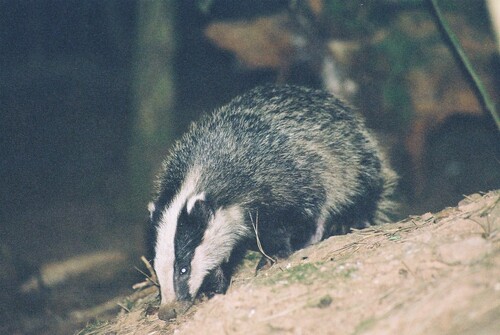
Photo: no rights reserved (CC0) — via iNaturalist
European Badger
Meles meles
Lives underground in big burrow systems called setts.
About the European Badger
The European badger is a heavily built member of the weasel family with a distinctive black and white striped face. It is far more social than its relatives, living in clans in extensive underground setts that are dug, extended and occupied across generations — some in continuous use for over a century.
How it lives
A sett can run to dozens of chambers and entrances with separate sleeping and latrine areas, and badgers regularly drag out old bedding and bring in fresh grass and leaves. They emerge at dusk and feed heavily on earthworms, which can make up most of the diet, along with insects, small mammals, fruit and cereals. They do not truly hibernate but reduce activity sharply in winter. Females use delayed implantation, so cubs are born in midwinter regardless of when mating occurred.
Where it lives
Lives underground in big burrow systems called setts. Its main habitat is the European Woodlands, where the climate is mild, temperate seasons with cool rain and gentle summers.
Notable facts
- Their setts can be used by families for centuries.
- They're tidy and dig toilets away from their dens.
- Mostly active at night, snuffling for earthworms.
Conservation
IUCN Red List status: Least concern. Assessed as not currently at risk of extinction in the wild.
Badgers are of least concern and common across Europe, and they are legally protected in Britain, where setts cannot be disturbed. The controversy attached to them is bovine tuberculosis: badgers can carry and transmit it to cattle, and culling programmes intended to reduce that transmission have been scientifically contested and politically bitter. Road traffic is the largest single cause of badger death.
Read the Wikipedia article →