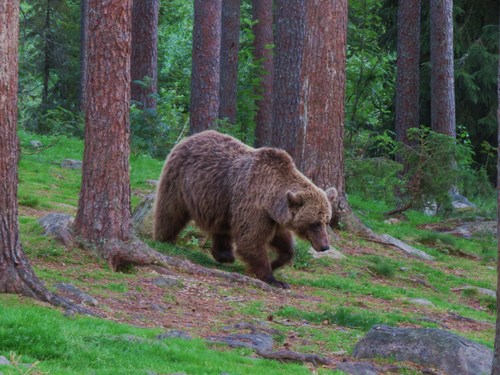
Photo: (c) Annika Lindqvist, some rights reserved (CC BY) — via iNaturalist
Brown Bear
Ursus arctos
Roams forests and mountains, fattening up before winter sleep.
About the Brown Bear
The brown bear is one of the most widely distributed bears in the world, found across Eurasia and North America in forms that differ enormously — from the Eurasian brown bears of European forest to the coastal giants of Alaska and Kamchatka. Size tracks food supply closely, and a bear with access to salmon grows far larger than one living on berries and roots.
How it lives
Brown bears are omnivores whose diet is mostly vegetable — grasses, herbs, roots, nuts and above all berries in the autumn, when they eat almost continuously to build the fat reserve that carries them through winter. They dig extensively for roots and burrowing rodents, and that digging turns over soil at a scale that measurably affects plant communities. Winter is spent in a den in a dormant state, with body temperature dropping only modestly, and cubs are born during it. Bears learn food sources from their mothers and return to them for life.
Where it lives
Roams forests and mountains, fattening up before winter sleep. Its main habitat is the European Woodlands, where the climate is mild, temperate seasons with cool rain and gentle summers.
Notable facts
- Found across Europe, Asia and North America.
- It can run as fast as a horse over short bursts.
- It hibernates for up to half the year.
Conservation
IUCN Red List status: Least concern. Assessed as not currently at risk of extinction in the wild.
Globally the brown bear is of least concern with a large total population, concentrated in Russia, North America and Scandinavia. The picture in western and southern Europe is very different, where small isolated populations in the Pyrenees, the Alps and central Italy number in the tens and depend on active management. Conflict over livestock, beehives and orchards, and the presence of bears near settlements, drive most of the killing.
Read the Wikipedia article →Habitats where the Brown Bear is found
European Woodlands
Storybook woods of foxes, deer and badgers at the edge of towns.
248 species recorded →Himalayas & High Asia
The rooftop of the world, where ghostly cats prowl above the clouds.
353 species recorded →