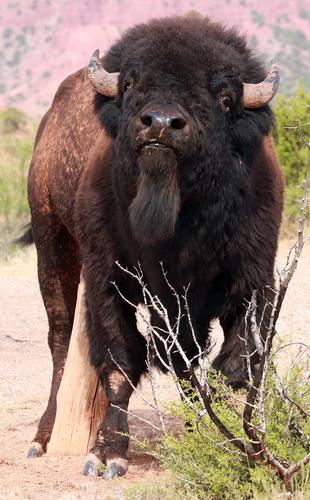
Photo: (c) Catherine C. Galley, some rights reserved (CC BY) — via iNaturalist
American Bison
Bison bison
Roams open prairie in herds, grazing the great grasslands.
About the American Bison
The American bison is the largest land mammal in North America, a massive-shouldered grazer with a low-slung head built for pushing through snow. It once existed in numbers that are hard to credit — tens of millions moving across the Great Plains — and was reduced to a few hundred animals within a single human lifetime.
How it lives
Bison graze grasses and sedges and move constantly, which is what made them so consequential ecologically: their grazing, trampling and wallowing created a shifting mosaic of vegetation heights that a great many prairie species depend on. They can run considerably faster than they look capable of and can pivot sharply. Bulls join the herd for the summer rut, bellowing and wallowing in dust; outside it they are largely separate. Calves are born bright orange and darken over months.
Where it lives
Roams open prairie in herds, grazing the great grasslands. Its main habitat is the North American Wilds, where the climate is four strong seasons with snowy winters and warm summers.
Notable facts
- The largest land animal in North America.
- Despite their bulk they can run at 55 km/h.
- Once numbered in the tens of millions across the plains.
Conservation
IUCN Red List status: Near threatened. Not threatened today, but close to qualifying and likely to become so without action.
Bison are near threatened, which sounds odd for an animal now numbering in the hundreds of thousands — but the great majority are commercial livestock, many carrying cattle genes, and the conservation herds are small, fenced and managed. Fewer than a handful of populations are large enough and free-ranging enough to function ecologically. The Plains Indian nations who lost everything with the bison have been central to the recent restoration effort.
Read the Wikipedia article →