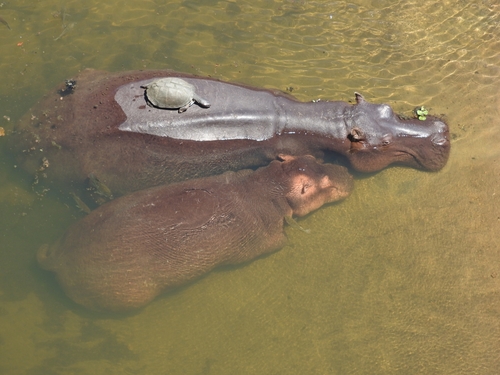
Photo: (c) Noeleen du Toit, some rights reserved (CC BY-SA) — via iNaturalist
Hippopotamus
Hippopotamus amphibius
Spends hot days submerged in rivers and lakes, grazing on land at night.
About the Hippopotamus
Hippos spend their days submerged and their nights on land, and the split defines them. Their skin loses water fast in dry air, so daylight is passed in rivers, lakes and wallows with only eyes, ears and nostrils above the surface. The reddish secretion often called blood sweat is neither — it is a pigmented fluid that works as a sunscreen and appears to have antibacterial properties.
How it lives
After dark, hippos walk out to graze, sometimes covering several kilometres and cropping grass with their broad lips rather than their teeth. The enormous tusk-like canines are weapons, not feeding tools. Pods hold a dominant bull with females and young, and bulls defend stretches of water with real violence. Calves are born and often suckle underwater. Hippo dung fertilises river systems on a scale that measurably supports fish populations downstream.
Where it lives
Spends hot days submerged in rivers and lakes, grazing on land at night. Its main habitat is the African Savanna, where the climate is hot all year with dramatic wet and dry seasons, typically 25–35°C.
Notable facts
- One of Africa's most dangerous large animals.
- They make their own 'sunscreen' — a reddish oily sweat.
- Despite their bulk, they can't actually swim — they walk underwater.
Conservation
IUCN Red List status: Vulnerable. Facing a high risk of extinction in the wild.
Hippos have been lost from much of West Africa and are declining in many other places. The two immediate pressures are unregulated hunting for meat and for the ivory in their teeth, and competition for water — as rivers are drawn down for irrigation, the pools hippos depend on shrink and the animals are pushed into contact with farmland.
Read the Wikipedia article →