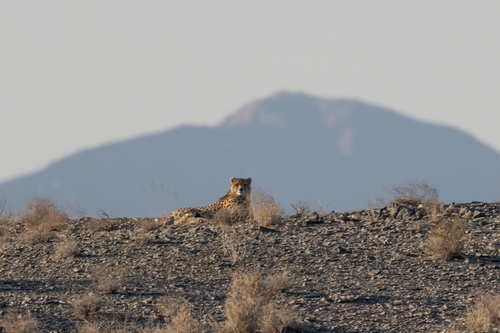
Photo: (c) موسی مزینانیان Mousa Mazinanian, some rights reserved (CC BY) — via iNaturalist
Cheetah
Acinonyx jubatus
Hunts on open plains where it has room to reach blistering top speed.
About the Cheetah
The cheetah is the fastest land animal, and nearly everything about it is subordinated to that fact: a light frame, a deep chest, a long spine that flexes like a spring, semi-retractable claws that work like sprint spikes, and a long tail used as a rudder. It is the least cat-like of the big cats — it cannot roar, and it hunts in daylight, when the stronger predators that would rob it are resting.
How it lives
A cheetah stalks close, then commits to a burst that is over in under a minute. The run costs so much that the animal must rest before it can eat, and that pause is when lions and hyenas take the kill. Females raise cubs alone and move them constantly; cub mortality is very high. Males, unusually, often form lifelong coalitions with their brothers and hold territory together.
Where it lives
Hunts on open plains where it has room to reach blistering top speed. Its main habitat is the African Savanna, where the climate is hot all year with dramatic wet and dry seasons, typically 25–35°C.
Notable facts
- The fastest land animal — over 100 km/h in seconds.
- Black 'tear marks' cut sun glare while sprinting.
- Unlike most cats, cheetahs can't fully retract their claws.
Conservation
IUCN Red List status: Vulnerable. Facing a high risk of extinction in the wild.
Cheetahs need very large areas and mostly live outside protected reserves, which puts them in constant contact with livestock farming. The species also carries unusually low genetic diversity from an ancient population bottleneck, leaving it vulnerable to disease. Cubs are taken for the illegal pet trade, particularly out of the Horn of Africa, and few survive the journey.
Read the Wikipedia article →