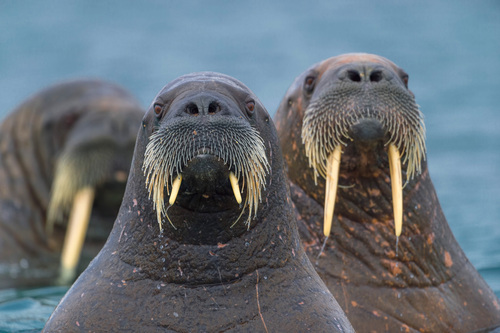
Photo: (c) Morten Ross, some rights reserved (CC BY) — via iNaturalist
Walrus
Odobenus rosmarus
Hauls out on ice and shores in huge herds, diving for shellfish.
About the Walrus
Walruses are unmistakable: enormous, wrinkled, whiskered, and carrying tusks that both sexes grow throughout life. The tusks are elongated canines used for hauling the animal out onto ice, for cutting breathing holes, and for settling dominance disputes — not, as was long assumed, for digging up food.
How it lives
Walruses feed on the sea floor in relatively shallow water, using an extremely sensitive array of stiff whiskers to find clams and other invertebrates in the sediment, then suctioning the soft parts out with a piston-like tongue. An adult can get through thousands of clams in a single feeding session. They are intensely social, hauling out in dense heaps on ice floes and beaches, and they need those floes to be over water shallow enough to feed in.
Where it lives
Hauls out on ice and shores in huge herds, diving for shellfish. Its main habitat is the Arctic & Tundra, where the climate is long frozen winters far below 0°C and a short, cool summer.
Notable facts
- Both males and females grow long tusks.
- Whiskers help it feel for clams on the seabed.
- It can stay underwater for up to 30 minutes.
Conservation
IUCN Red List status: Vulnerable. Facing a high risk of extinction in the wild.
Walruses are vulnerable, and the specific problem is that sea ice is retreating off the shallow continental shelves where they feed. When ice is unavailable they haul out on land in enormous concentrations, where stampedes triggered by disturbance kill large numbers of calves, and where the surrounding sea floor gets stripped of food. Subsistence hunting is regulated and is not the main pressure.
Read the Wikipedia article →