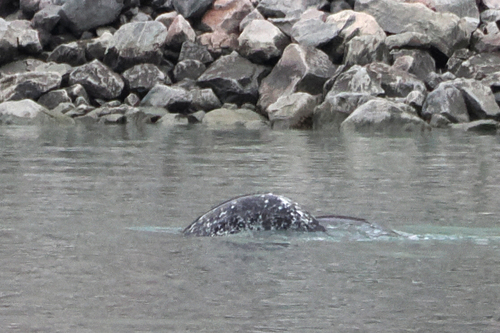
Photo: no rights reserved — via iNaturalist
Narwhal
Monodon monoceros
Swims under Arctic sea ice in pods, diving deep for fish.
About the Narwhal
The narwhal is a medium-sized Arctic whale with no dorsal fin and, in males, a single spiralled tusk that can grow to several metres. The tusk is a tooth — the left canine, grown straight through the upper lip — and it is packed with nerve endings, making it a sensory organ as much as a weapon or ornament. Narwhals were the original source of unicorn horn in medieval Europe.
How it lives
Narwhals live further north, year round, than almost any other whale, wintering in dense pack ice and moving to coastal bays in summer. They dive extremely deep and for long periods to feed on Greenland halibut, squid and shrimp, often under near-total ice cover, navigating between cracks and breathing holes. They travel in pods and are highly vocal. Males have been observed using the tusk to stun fish, which was only recently documented.
Where it lives
Swims under Arctic sea ice in pods, diving deep for fish. Its main habitat is the Arctic & Tundra, where the climate is long frozen winters far below 0°C and a short, cool summer.
Notable facts
- Its 'horn' is actually a giant spiralled tooth.
- Sometimes called the 'unicorn of the sea'.
- The tusk can grow up to 3 m long.
Conservation
IUCN Red List status: Least concern. Assessed as not currently at risk of extinction in the wild.
Narwhals are listed as of least concern but the assessment carries real uncertainty, and they are among the Arctic species considered most sensitive to change. They are specialised to a narrow range of conditions, tied to specific migration routes, and unusually vulnerable to underwater noise from shipping and seismic surveying, which is increasing sharply as ice retreats. Entrapment events, where shifting ice closes over a pod, can kill hundreds at once.
Read the Wikipedia article →