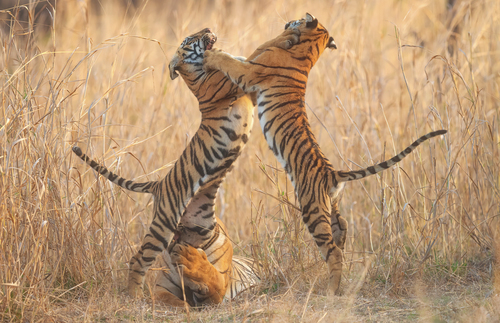
Photo: (c) Morten Ross, some rights reserved (CC BY) — via iNaturalist
Tiger
Panthera tigris
Hunts alone through jungle and grassland, often near water.
About the Tiger
The tiger is the largest cat in the world and the only one with stripes, which are marked on the skin as well as the fur and are individually unique. It is an ambush hunter of dense cover — forest, tall grass, mangrove, snow-covered taiga — and the stripes work in exactly that broken, vertical light. Unusually for a cat, tigers like water and swim well.
How it lives
Tigers are solitary and territorial, with a male's range overlapping several females. They hunt mostly at night, stalking to within a short distance and then rushing, and they need a large kill roughly once a week. Most attempts fail. Cubs stay with their mother for around two years, learning to hunt, and dispersing young males looking for territory are the animals most likely to run into trouble with people. Communication is by scent marking, scrapes and long-carrying calls rather than by meeting.
Where it lives
Hunts alone through jungle and grassland, often near water. Its main habitat is the Southeast Asian Jungle, where the climate is hot and steamy with monsoon downpours.
Notable facts
- The largest cat in the world.
- Its stripes are unique, and its skin is striped too.
- Unlike most cats, tigers love to swim.
Conservation
IUCN Red List status: Endangered. Facing a very high risk of extinction in the wild.
Tigers are endangered, occupying a small percentage of their historical range, though the global count has begun climbing again after decades of decline — the first sustained increase in a century. Poaching for skins and for body parts used in traditional medicine remains the acute threat, alongside prey depletion and the fragmentation of forest into blocks too small to hold a breeding population. Recovery has been strongest in India, Nepal and Russia, where protection and prey restoration have been sustained.
Read the Wikipedia article →