Photo: no rights reserved — via iNaturalist
Komodo Dragon
Varanus komodoensis
Patrols hot, dry islands of Indonesia, basking on rocky ground.
About the Komodo Dragon
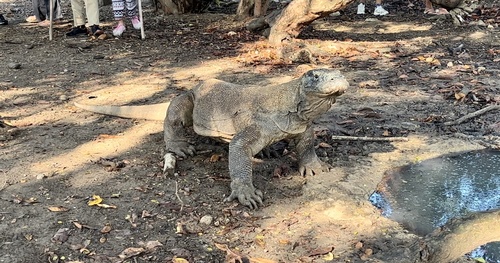
The Komodo dragon is the largest living lizard, restricted to a handful of Indonesian islands. It is a monitor lizard scaled up, and it dominates its islands the way a large mammalian carnivore would elsewhere — an example of what happens on islands with no competing predators.
How it lives
Komodos hunt deer, pigs, water buffalo and carrion, locating food by scent over long distances with a deeply forked tongue. They can sprint in short bursts and take prey directly, and their bite combines serrated teeth that open large wounds with venom glands that produce anticoagulants and cause a sharp drop in blood pressure — the long-standing story about septic bacteria in the mouth has not held up. Young dragons live in trees for their first years, which keeps them away from adults that would eat them. Females can reproduce without a male.
Where it lives
Patrols hot, dry islands of Indonesia, basking on rocky ground. Its main habitat is the Southeast Asian Jungle, where the climate is hot and steamy with monsoon downpours.
Notable facts
- The largest lizard alive today.
- Its bite is venomous.
- It can smell carrion from kilometres away with its tongue.
Conservation
IUCN Red List status: Endangered. Facing a very high risk of extinction in the wild.
The species is endangered, with a small total population confined to a few islands and a very restricted range. The specific risks are the loss of prey to human hunting, habitat change on the islands, and — because the population sits at low elevation on small islands — sea level rise, which is projected to remove a significant share of suitable habitat. Komodo National Park protects the core population.
Read the Wikipedia article →