Photo: (c) Blair Dudeck, some rights reserved (CC BY) — via iNaturalist
Sun Bear
Helarctos malayanus
Climbs rainforest trees in search of fruit, honey and insects.
About the Sun Bear
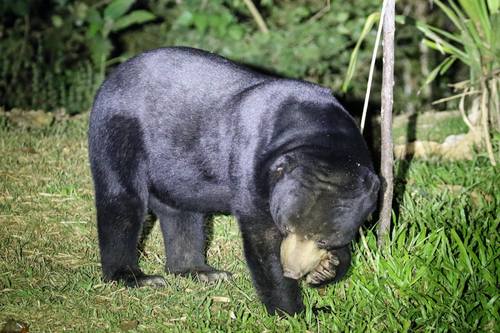
The sun bear is the smallest bear in the world, living in the lowland forests of Southeast Asia. It takes its name from the pale crescent on its chest, which varies in shape between individuals. The muzzle is short and pale, the claws are long and curved, and the tongue is remarkably long — an obvious adaptation to what it eats.
How it lives
Sun bears are excellent climbers and spend a great deal of time in trees, tearing into rotten wood and bee nests with their claws and extracting insects, larvae and honey with that tongue. They also eat fruit, and in doing so disperse seeds through the forest, and their excavation of nest holes creates cavities that other species depend on. Loose skin around the neck lets a bear twist round and bite if a predator gets hold of it. They are mostly nocturnal and solitary, and they do not hibernate.
Where it lives
Climbs rainforest trees in search of fruit, honey and insects. Its main habitat is the Southeast Asian Jungle, where the climate is hot and steamy with monsoon downpours.
Notable facts
- The smallest bear in the world.
- A golden chest patch is said to look like the rising sun.
- Its tongue can be 25 cm long for slurping honey.
Conservation
IUCN Red List status: Vulnerable. Facing a high risk of extinction in the wild.
Sun bears are vulnerable and declining. Forest conversion for plantation agriculture is the underlying cause; the direct ones are poaching for gall bladders and paws, capture of cubs for the pet trade, and killing in retaliation for damage to crops. The species has already been lost from parts of its range, and because it lives at low density in lowland forest — the forest type most likely to be cleared — it is especially exposed.
Read the Wikipedia article →