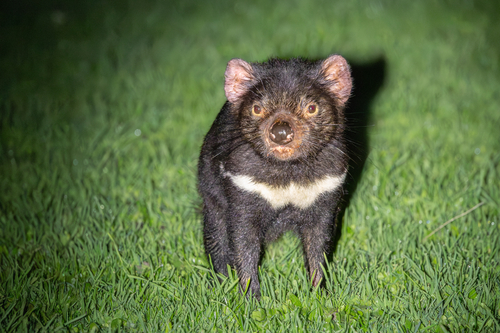
Photo: (c) Ramit Singal, some rights reserved (CC BY) — via iNaturalist
Tasmanian Devil
Sarcophilus harrisii
Prowls Tasmanian forest and scrub at night, mostly scavenging.
About the Tasmanian Devil
The Tasmanian devil is the largest carnivorous marsupial left, following the extinction of the thylacine. It is a stocky, black, thick-tailed animal about the size of a small dog, with a bite force among the strongest of any land mammal for its size — strong enough to consume bone, fur and everything else on a carcass.
How it lives
Devils are mostly scavengers and mostly nocturnal, and their role is essentially a cleanup one: they find carcasses by smell and leave very little behind. The screeching and gaping that gave them their name is largely bluff, a way of sorting out access to a carcass without a real fight. They den in hollow logs, caves and burrows. Females have more young than they have teats, so only the first few to reach the pouch survive, and those that do stay for around four months.
Where it lives
Prowls Tasmanian forest and scrub at night, mostly scavenging. Its main habitat is the Australian Outback, where the climate is hot, dry and blazing-bright across the interior.
Notable facts
- The largest carnivorous marsupial alive.
- It has one of the strongest bites for its size.
- Its blood-curdling screech earned it its name.
Conservation
IUCN Red List status: Endangered. Facing a very high risk of extinction in the wild.
The devil is endangered because of devil facial tumour disease, a transmissible cancer spread by biting, which has killed the large majority of the wild population since the 1990s. It is one of very few contagious cancers known in nature. There is some evidence of populations evolving resistance and of the disease becoming less lethal, and insurance populations have been established on the mainland and on Maria Island. Roadkill remains a significant additional loss.
Read the Wikipedia article →