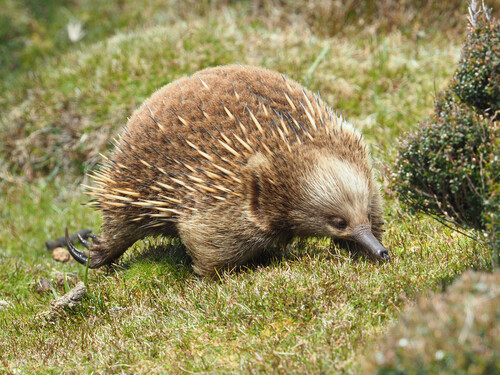
Photo: (c) gwynmwilliams, some rights reserved (CC BY) — via iNaturalist
Echidna
Tachyglossidae
Snuffles through bush and desert, digging for ants and termites.
About the Echidna
Echidnas are, with the platypus, the only mammals that lay eggs. They are covered in sharp spines over a coat of fur, they have no teeth, and they carry a long sticky tongue in a tubular snout that is also studded with electroreceptors — a sense they share with the platypus and almost no other land mammal.
How it lives
An echidna feeds by breaking into ant and termite nests with powerful claws and flicking its tongue through the galleries, grinding the catch between pads at the base of the tongue and the roof of the mouth. Threatened, it does not run: it digs straight down until only spines are showing, or wedges itself under a rock. It has an unusually low body temperature and can slow its metabolism dramatically, which allows it to survive fires by sheltering underground and to enter torpor in cold weather. The female lays a single egg into a temporary pouch, and the young — called a puggle — is evicted once its spines develop.
Where it lives
Snuffles through bush and desert, digging for ants and termites. Its main habitat is the Australian Outback, where the climate is hot, dry and blazing-bright across the interior.
Notable facts
- Like the platypus, it's an egg-laying mammal.
- It has no teeth and laps up ants with a sticky tongue.
- When scared it curls into a spiny ball.
Conservation
IUCN Red List status: Least concern. Assessed as not currently at risk of extinction in the wild.
The short-beaked echidna is of least concern and is found across Australia and New Guinea in almost every habitat, from desert to alpine. The long-beaked echidnas of New Guinea are a very different story and are critically endangered from hunting. The everyday risks to the common species are vehicles, dogs and habitat clearing.
Read the Wikipedia article →