Photo: no rights reserved — via iNaturalist
Platypus
Ornithorhynchus anatinus
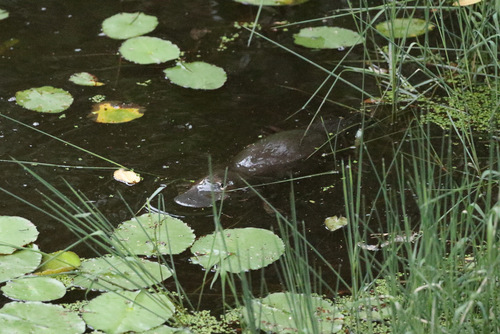
Hunts in freshwater streams, hunting with its eyes shut.
About the Platypus
The platypus is one of only a handful of egg-laying mammals, and when the first specimen reached Britain it was assumed to be a hoax stitched together from other animals. It has a duck-like bill, webbed feet, dense waterproof fur, no teeth as an adult, and — in males — a venomous spur on each hind leg capable of causing severe and long-lasting pain.
How it lives
Platypuses hunt underwater with their eyes, ears and nostrils shut, which means the bill does all the work. It is packed with electroreceptors and mechanoreceptors that pick up the faint electrical signals of muscle contractions in shrimp, insect larvae and worms buried in the streambed. They store food in cheek pouches and grind it at the surface using horny plates. They live in burrows in the banks of rivers and streams in eastern Australia, and females seal themselves in to incubate eggs and nurse young — which lap milk from the skin, since there are no nipples.
Where it lives
Hunts in freshwater streams, hunting with its eyes shut. Its main habitat is the Australian Outback, where the climate is hot, dry and blazing-bright across the interior.
Notable facts
- A mammal that lays eggs.
- Males have a venomous spur on each hind leg.
- It senses prey using electricity through its bill.
Conservation
IUCN Red List status: Near threatened. Not threatened today, but close to qualifying and likely to become so without action.
The platypus is near threatened and the trend has been downward, though it remains widespread. The pressures are river regulation and extraction, drought and the drying of streams, land clearing along waterways, and drowning in illegal yabby traps and discarded litter. It has already disappeared from parts of its former range in South Australia and from many catchments in decline.
Read the Wikipedia article →