Photo: (c) Aitor, some rights reserved (CC BY) — via iNaturalist
Three-toed Sloth
Bradypus
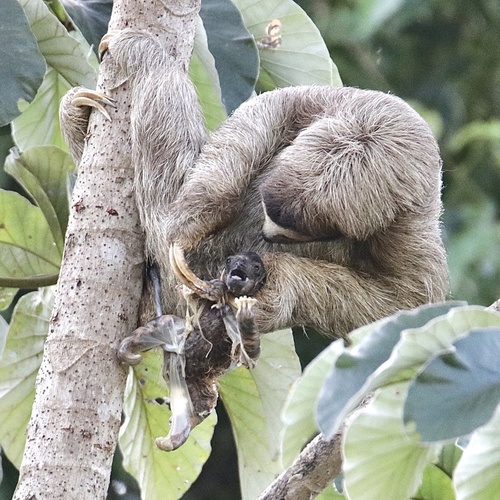
Hangs upside-down in rainforest treetops, barely moving all day.
About the Three-toed Sloth
Three-toed sloths are built around the economics of eating leaves, which yield very little energy and take a very long time to digest. Everything follows from that: a low body temperature, a metabolic rate among the lowest of any mammal, minimal muscle mass, and movement slow enough that the animal is easy to miss even when you are looking straight at it.
How it lives
A sloth hangs upside down from curved claws that lock in place, requiring almost no effort to hold on, and it can stay in one tree for days. Its fur grows in the opposite direction to most mammals so rain runs off while hanging, and it hosts algae that tint the coat green and help it disappear into the canopy, along with moths that live nowhere else. Roughly once a week it descends to the ground to defecate, which is the most dangerous thing it does. Sloths are also strong swimmers, considerably faster in water than on land.
Where it lives
Hangs upside-down in rainforest treetops, barely moving all day. Its main habitat is the Amazon Rainforest, where the climate is warm and extremely humid with heavy rainfall all year round.
Notable facts
- One of the slowest animals on Earth.
- Green algae grows in its fur as camouflage.
- It only comes down to the ground about once a week.
Conservation
IUCN Red List status: Least concern. Assessed as not currently at risk of extinction in the wild.
The common three-toed sloths are not threatened, though the maned sloth of the Brazilian Atlantic forest and the pygmy sloth of Panama are in serious trouble. The everyday risks are deforestation, road deaths, power line electrocution, and dogs. Sloths handled for tourist photographs suffer badly from the stress, which is not visible because the animal cannot show it.
Read the Wikipedia article →