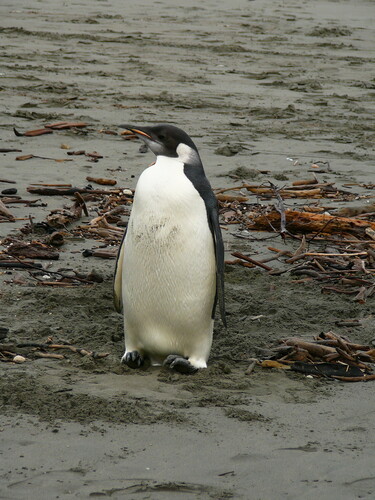
Photo: (c) mattward, some rights reserved (CC BY-SA) — via iNaturalist
Emperor Penguin
Aptenodytes forsteri
Breeds on sea ice through the brutal Antarctic winter.
About the Emperor Penguin
The emperor is the largest penguin and the only bird that breeds through the Antarctic winter, on sea ice, in darkness, in temperatures far below freezing and winds that would kill an unprepared human in minutes. Everything about the species is a response to that decision — dense overlapping feathers, a thick fat layer, small extremities, and a social system built on shared body heat.
How it lives
Emperors walk and toboggan long distances inland to traditional breeding sites in autumn. The female lays a single egg, transfers it to the male, and returns to the sea to feed. The male balances the egg on his feet under a fold of skin and fasts for around two months through the worst of the winter, huddling with thousands of other males in a mass that slowly rotates so that every bird gets time out of the wind. Chicks hatch as the female returns with food. Adults are superb divers, going deeper and staying under longer than any other bird.
Where it lives
Breeds on sea ice through the brutal Antarctic winter. Its main habitat is Antarctica, where the climate is earth's coldest, windiest place, plunging to −60°C.
Notable facts
- The tallest and heaviest penguin.
- Males balance the egg on their feet for two months.
- They huddle by the thousand to share warmth.
Conservation
IUCN Red List status: Near threatened. Not threatened today, but close to qualifying and likely to become so without action.
Emperor penguins are near threatened and are one of the species most directly exposed to sea ice change, because they breed on ice that has to stay fast to the shore for the full breeding cycle. Several colonies have already suffered total breeding failure when the ice broke out early. Projections for the species track projections for Antarctic fast ice almost exactly.
Read the Wikipedia article →