Photo: (c) Flavien Saboureau, some rights reserved (CC BY) — via iNaturalist
Wandering Albatross
Diomedea exulans
Glides over the Southern Ocean for years, barely touching land.
About the Wandering Albatross
The wandering albatross has the largest wingspan of any living bird, and it uses it to do something no other animal does as well: extract energy from the wind gradient over the Southern Ocean and travel almost indefinitely without flapping. A shoulder lock holds the wings extended without muscular effort. Individual birds circumnavigate Antarctica repeatedly.
How it lives
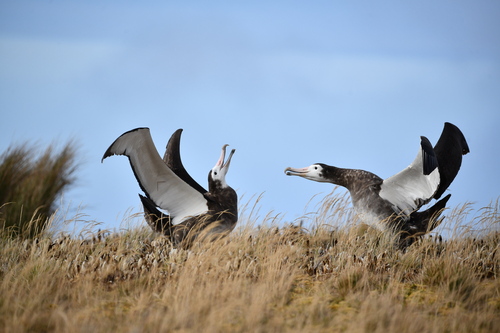
Albatrosses spend years continuously at sea before ever returning to land, feeding on squid, fish and carrion taken from the surface. They breed on remote subantarctic islands, and the courtship — bill clacking, sky-pointing, wing spreading — is elaborate and takes several seasons to work through before a pair forms. Pairs are famously long-lasting. They raise one chick roughly every two years, and the chick sits on the nest for the better part of a year while both parents forage thousands of kilometres out and back.
Where it lives
Glides over the Southern Ocean for years, barely touching land. Its main habitat is Antarctica, where the climate is earth's coldest, windiest place, plunging to −60°C.
Notable facts
- The longest wingspan of any bird — up to 3.5 m.
- It can glide for hours without a single flap.
- Pairs reunite with a noisy dance and stay together for life.
Conservation
IUCN Red List status: Vulnerable. Facing a high risk of extinction in the wild.
Wandering albatrosses are vulnerable and the main killer is longline fishing: birds take baited hooks as they are set, get dragged under and drown. Because the species breeds so slowly, mortality of even a small number of breeding adults each year drives decline. Simple mitigation — setting lines at night, weighting them, using bird-scaring streamers — works well where fleets adopt it, and the problem is now largely one of compliance rather than technique.
Read the Wikipedia article →