Photo: (c) Vsevolod Rudyi, some rights reserved (CC BY) — via iNaturalist
Addax
Addax nasomaculatus
Wanders the deepest desert, following rare rains to fresh plants.
About the Addax
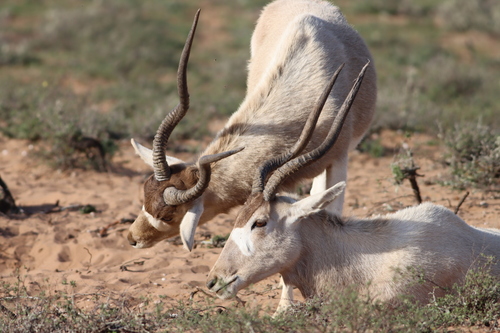
The addax is a desert antelope with spiralled horns and a coat that turns almost white in summer, reflecting heat. It is adapted to conditions that would kill most large herbivores: it can live without drinking, taking water from the plants it eats and from dew, and its splayed hooves spread its weight on soft sand.
How it lives
Addax follow rainfall across the Sahara, moving to wherever sparse desert grasses and shrubs have come up after a storm. They are most active in the cooler hours and rest in shade or in shallow depressions they scrape out during the heat of the day. Herds were historically large and led by a dominant male. Their reliance on unpredictable, widely separated patches of growth means they must range over enormous distances.
Where it lives
Wanders the deepest desert, following rare rains to fresh plants. Its main habitat is the Sahara & Deserts, where the climate is scorching days above 45°C and surprisingly freezing nights.
Notable facts
- One of the rarest mammals on Earth.
- Its coat turns nearly white to reflect summer heat.
- Splayed hooves stop it sinking into soft sand.
Conservation
IUCN Red List status: Critically endangered. Facing an extremely high risk of extinction in the wild.
The addax is one of the most endangered large mammals on Earth, reduced to a tiny wild population in a small part of Niger. The cause is straightforward and almost entirely human: it is a slow, conspicuous animal on open ground, and motorised hunting removed it from nearly its whole range. Oil development and associated traffic in its last stronghold have made the remaining animals harder to protect. Captive herds are substantial, and reintroduction is the realistic route back.
Read the Wikipedia article →