Photo: no rights reserved — via iNaturalist
Golden Snub-nosed Monkey
Rhinopithecus roxellana
Roams cold mountain forests in large, noisy troops.
About the Golden Snub-nosed Monkey
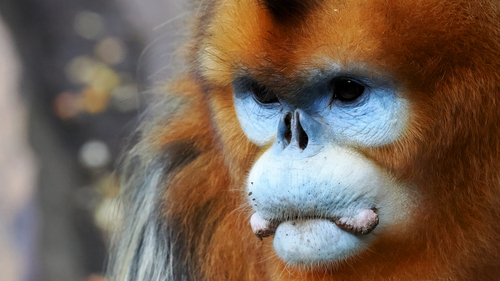
The golden snub-nosed monkey lives in the mountain forests of central China at altitudes where it endures snow for months of the year — it tolerates colder average temperatures than any other non-human primate. It has long golden fur, a strikingly blue face, and almost no nose bridge, an arrangement often explained as a defence against frostbite though the evidence for that is not settled.
How it lives
These monkeys live in some of the largest groups of any primate, aggregations that can run into the hundreds and are built from smaller one-male family units that travel together. They feed on lichens through the winter — an unusual staple that ties them to old-growth forest, since the lichens they need take a long time to establish — and switch to leaves, buds, fruit and bark in warmer months. They move seasonally up and down the mountain and are highly vocal, calling to each other without visible movement of the mouth.
Where it lives
Roams cold mountain forests in large, noisy troops. Its main habitat is China's Bamboo Forests, where the climate is cool, misty and damp in the mountain forests.
Notable facts
- It survives snowy forests few monkeys could endure.
- Its tiny upturned nose may stop frostbite.
- Troops can swell to several hundred members.
Conservation
IUCN Red List status: Endangered. Facing a very high risk of extinction in the wild.
The species is endangered, confined to a handful of separated mountain blocks in Sichuan, Shaanxi, Gansu and Hubei. Historical logging removed much of the old-growth forest and the lichen load it carried, and the remaining populations are isolated from each other. Protection has improved and some populations have stabilised, but the dependence on mature forest means recovery cannot be quick.
Read the Wikipedia article →