Photo: no rights reserved — via iNaturalist
Giant Panda
Ailuropoda melanoleuca
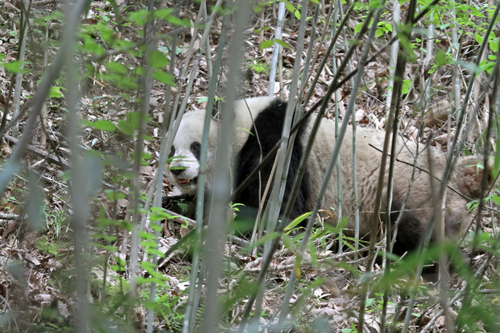
Lives alone in misty mountain bamboo forests, eating all day.
About the Giant Panda
The giant panda is a bear that decided to eat bamboo. It retains the digestive system of a carnivore — short gut, no rumen, carnivore gut bacteria — and gets very little out of the plant, which is why it must eat for the better part of every day and why it moves as little as it can between meals.
How it lives
A panda gets through an enormous mass of bamboo daily, gripping stems with an enlarged wrist bone that works as a sixth digit and stripping them with powerful jaws and broad crushing molars. It eats a small number of bamboo species and needs several of them, because bamboo flowers and dies off synchronously across large areas at long intervals, and a panda confined to a single species in a single valley starves when that happens. Pandas are solitary, communicate by scent marking, and give birth to cubs that are extraordinarily small relative to the mother.
Where it lives
Lives alone in misty mountain bamboo forests, eating all day. Its main habitat is China's Bamboo Forests, where the climate is cool, misty and damp in the mountain forests.
Notable facts
- It eats bamboo for up to 14 hours a day.
- A 'thumb' made from a wrist bone helps it grip stalks.
- Newborn cubs are smaller than a stick of butter.
Conservation
IUCN Red List status: Vulnerable. Facing a high risk of extinction in the wild.
The giant panda was downlisted from endangered to vulnerable after decades of sustained work — a substantial expansion of reserves, a logging ban across its range, and a captive breeding programme that eventually solved the problems that had made it notoriously difficult. Roughly two thirds of wild pandas now live inside protected areas. The remaining issue is fragmentation: the population is split into isolated groups by roads, railways and farmland, and connecting them with habitat corridors is the current priority.
Read the Wikipedia article →