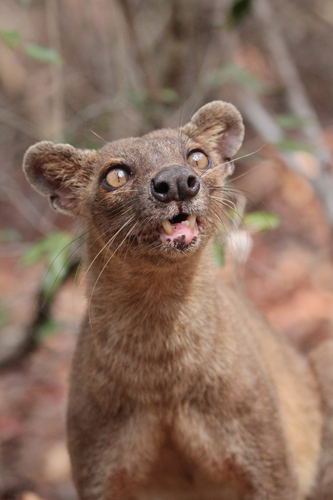
Photo: (c) Rob Foster, some rights reserved (CC BY) — via iNaturalist
Fossa
Cryptoprocta ferox
Hunts through forest canopy and ground, Madagascar's top predator.
About the Fossa
The fossa is Madagascar's largest carnivore and its top predator, and it looks like a cat crossed with a mongoose because it is neither — it belongs to a family of carnivores found only on Madagascar, descended from a single mongoose-like ancestor that reached the island millions of years ago. It is long-bodied, short-legged, and carries a tail as long as the rest of it.
How it lives
The fossa is an exceptional climber, with semi-retractable claws and ankles flexible enough to rotate, which lets it descend a trunk head-first and move through the canopy at speed. Lemurs make up a large part of its diet, along with rodents, birds, reptiles and insects, and it hunts by day or night depending on what it is after. It is usually solitary and holds a large territory. During breeding, a female occupies a particular tree and males gather beneath it over the course of a week or more.
Where it lives
Hunts through forest canopy and ground, Madagascar's top predator. Its main habitat is Madagascar, where the climate is tropical and warm with distinct wet and dry seasons.
Notable facts
- Madagascar's largest meat-eater.
- It's related to the mongoose, not the cat.
- Its long tail helps it race through the treetops.
Conservation
IUCN Red List status: Vulnerable. Facing a high risk of extinction in the wild.
The fossa is vulnerable, with a population thought to number in the low thousands and falling. Madagascar's forests have been reduced to a fraction of their original extent and continue to be cleared, and the fossa needs large continuous areas. It is also killed as a threat to poultry, and is exposed to diseases carried by village dogs and cats. As the island's apex predator, its loss changes lemur populations directly.
Read the Wikipedia article →