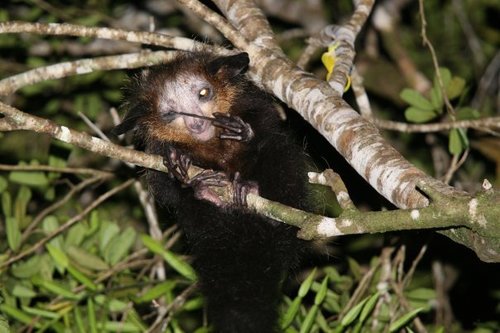
Photo: (c) novvictan, some rights reserved (CC BY) — via iNaturalist
Aye-aye
Daubentonia madagascariensis
Creeps through rainforest at night, tapping branches for grubs.
About the Aye-aye
The aye-aye is the strangest primate alive and among the strangest mammals of any kind: a nocturnal lemur with rodent-like ever-growing incisors, enormous mobile ears, coarse dark hair, and a middle finger that is skeletal, elongated, and mounted on a ball-and-socket joint. It fills the ecological role that woodpeckers occupy elsewhere, and Madagascar has no woodpeckers.
How it lives
It hunts by percussive foraging, tapping rapidly along a branch with that thin finger and listening to the returning sound with its ears to detect hollow galleries left by wood-boring grubs. Having found one, it gnaws through the wood with its incisors and hooks the larva out with the same finger. It also feeds on nectar, seeds and fruit, notably ramy nuts and coconuts. Aye-ayes are solitary, build spherical nests of leaves high in the canopy, and move through the trees at night over large ranges.
Where it lives
Creeps through rainforest at night, tapping branches for grubs. Its main habitat is Madagascar, where the climate is tropical and warm with distinct wet and dry seasons.
Notable facts
- The world's largest nocturnal primate.
- It has a long, bony middle finger for fishing out grubs.
- It taps wood and listens for hollow tunnels inside.
Conservation
IUCN Red List status: Endangered. Facing a very high risk of extinction in the wild.
The aye-aye is endangered from habitat loss and from being killed on sight. It is regarded as an omen of death in parts of Madagascar, and animals encountered near villages are frequently killed for that reason as well as in retaliation for raiding coconut and lychee crops. Because it is nocturnal, solitary and thinly spread, its true numbers are poorly known and probably lower than assumed.
Read the Wikipedia article →