Photo: no rights reserved — via iNaturalist
Panther Chameleon
Furcifer pardalis
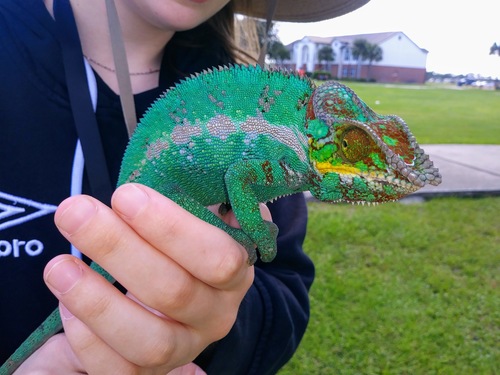
Perches in warm coastal forest, gripping twigs with mitten feet.
About the Panther Chameleon
The panther chameleon is among the most spectacularly coloured reptiles in the world, and its colour depends on where it comes from — populations in different parts of northern Madagascar are so distinct in pattern that they are referred to by locality names. Males are the vivid ones; females stay largely brown and green.
How it lives
Colour change in chameleons is not camouflage in the ordinary sense. It is achieved by adjusting a lattice of nanocrystals in the skin to reflect different wavelengths, and it signals mood, temperature regulation and readiness to fight or breed. The eyes rotate independently, giving nearly full coverage, and lock together onto a target the moment one finds it. The tongue is launched at extraordinary acceleration on an elastic mechanism and can exceed the animal's own body length. Feet are fused into opposed grasping bundles, and the tail is prehensile.
Where it lives
Perches in warm coastal forest, gripping twigs with mitten feet. Its main habitat is Madagascar, where the climate is tropical and warm with distinct wet and dry seasons.
Notable facts
- It changes colour with mood, not just to hide.
- Each eye can swivel in a different direction at once.
- Its tongue can shoot out longer than its whole body.
Conservation
IUCN Red List status: Least concern. Assessed as not currently at risk of extinction in the wild.
The panther chameleon is of least concern and remains reasonably common in the disturbed and edge habitats it tolerates well. It is heavily collected for the international pet trade under an export quota, and it is one of the more frequently traded reptiles from Madagascar. The wider risk is deforestation, which affects the more specialised chameleons of the island far more severely than this adaptable species.
Read the Wikipedia article →